
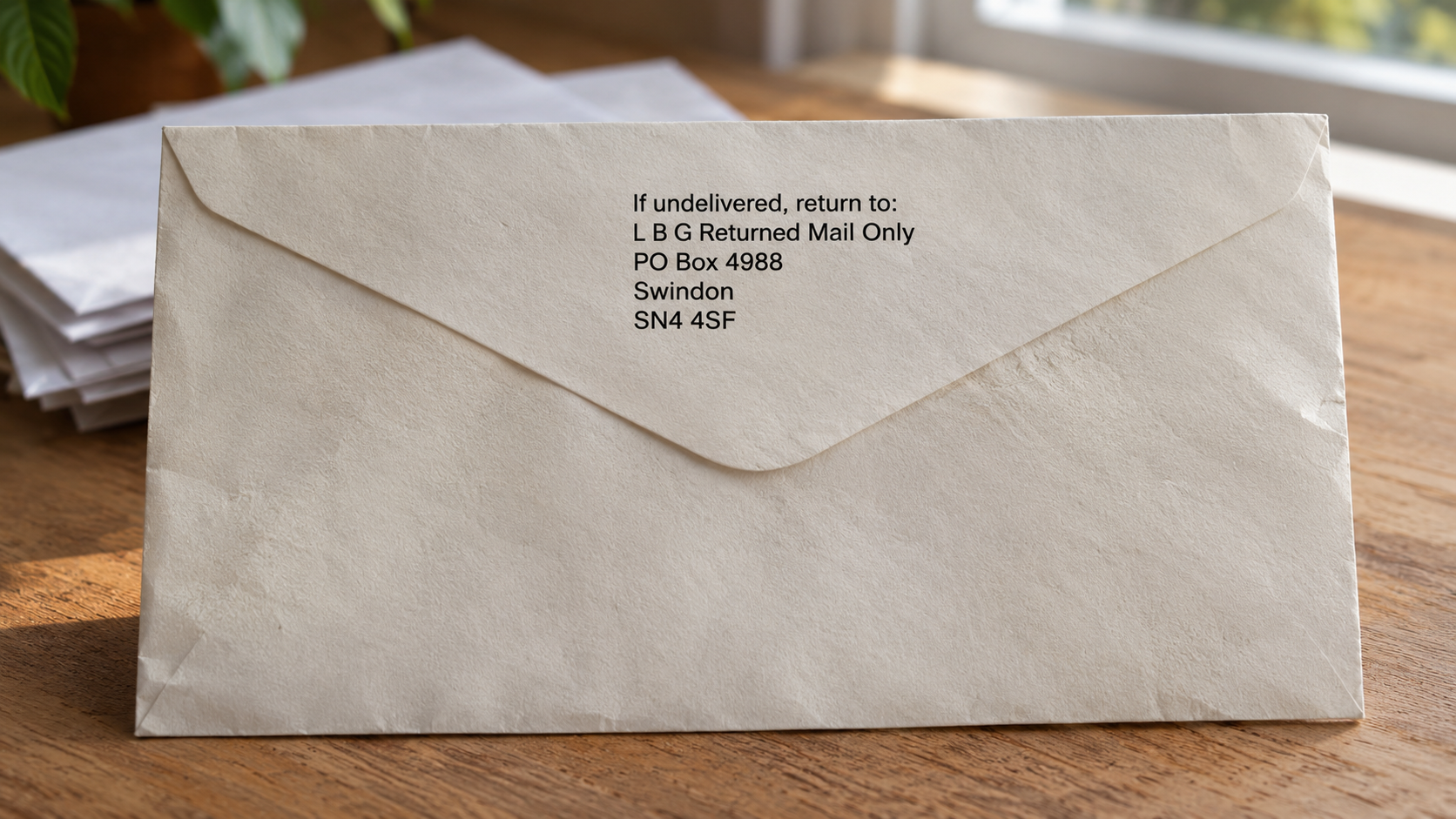
Royal Mail’s live Postcode Finder lists PO Box 4988, Swindon, SN4 4SF as “L B G Returned Mail Only”. It is a returned-mail address. The initials suggest a Lloyds Banking Group connection, but the listing does not identify a particular bank, department or reason for contacting you.
The listing was checked directly on 8 November 2026. If this address appears on an envelope you have received, the next step is to check the organisation named in the letter. A return address helps route undeliverable post; it does not, by itself, prove that a letter is genuine or explain what it concerns.
What Royal Mail’s listing tells you
Searching SN4 4SF in Royal Mail’s Postcode Finder produces this entry:
L B G Returned Mail Only, Po Box 4988
Swindon, SN4 4SF
The words “Returned Mail Only” are the most useful part of the record. They identify a destination for returned correspondence, rather than a general customer-service address.
That distinction matters when deciding where to send a reply. An address printed beside an instruction such as “If undelivered, return to” serves a different purpose from the reply address inside a letter.
Royal Mail offers PO Box services with either collection or onward delivery. A PO Box therefore should not be treated as a bank branch, company headquarters or public office you can visit.
Does “L B G” mean Lloyds Banking Group?
The initials are consistent with Lloyds Banking Group. The group explicitly uses the abbreviation “LBG” in its own publications, including a press release dated 15 July 2025. This supports that interpretation, although the Royal Mail entry itself does not spell out the name.
There are two separate questions here:
- What is the address used for? Royal Mail identifies it as a returned-mail address.
- Who sent your particular letter? That needs to be established from the contents and, where necessary, checked with the named organisation.
The postal listing does not reveal whether your letter concerns an account, an administrative update or another matter. It also does not establish which group business or department issued it.
If the letter names a Lloyds Banking Group business, use that business’s official customer-service channel. The group’s contact page provides a starting point for finding the appropriate contact.
Why some websites mention Zurich or a court
Online explanations of this PO Box have attached different organisations to it. A company’s presence in Swindon, however, is not enough to establish that it uses this exact address.
For example, Zurich’s official letter-of-authority page provides two different correspondence addresses:
- For life insurance policies beginning PR: Zurich Assurance, Protection Operations, PO Box 4157, Swindon, SN4 4QB.
- For policies not beginning PR: Zurich Assurance – In Force, Unity Place, 1 Carfax Close, Swindon, SN1 1AP.
Those details do not establish a Zurich connection to PO Box 4988. They also illustrate why the box number and postcode must be checked together: two addresses in the same town are not interchangeable.
Likewise, the official HM Courts & Tribunals Service directory lists Swindon Combined Court at The Law Courts, Islington Street, Swindon, SN1 2HG. It does not identify PO Box 4988 as the court’s published contact address.
Neither comparison rules out every possible administrative mailing arrangement. The practical point is narrower: do not label a letter as Zurich correspondence, a debt demand or a court notice solely because its envelope carries PO Box 4988.
How to check a letter carrying this address
If the letter is addressed to you, use the following checks before making a payment or providing sensitive information.
Read the sender details and requested action
Look for the organisation’s full name, the date, a customer or case reference, and a clear explanation of why it has contacted you.
Separate information from instructions. Does the letter simply notify you of a change, or does it ask you to telephone, complete a form, disclose information or pay money? The requested action determines what you need to verify.
Contact the organisation independently
Use an established banking app, contact details on your bank card, or the organisation’s official website. Do not rely solely on a telephone number, website address or QR code printed in unexpected correspondence.
Ask the organisation to confirm the letter’s date, reference and requested action. If you need to reply by post, ask for the correct address for that specific enquiry.
Keep security codes private
If an unexpected letter contains an activation code or other security information, do not share it with someone who subsequently contacts you.
Lloyds warns that callers asking for passcodes are fraudsters. It also says it will never telephone you to instruct you to move money to another account. A convincing letter or follow-up call does not remove the need for an independent check.
Check deadlines promptly
An unfamiliar return address is not a reason to ignore the contents.
If the letter appears to contain a court claim, contact the court through its official directory entry. GOV.UK’s guidance on money claims says recipients must respond by the date stated in the letter or email; failing to respond in time can lead to a county court judgment. Verify the document promptly while keeping its deadline in view.
Should you send a reply to PO Box 4988?
Do not assume that a returned-mail address accepts ordinary customer enquiries. Use the reply instructions in a letter you have verified, or obtain the appropriate address directly from the organisation.
This is particularly relevant for complaints, completed forms and original documents. Sending them to an address intended for undeliverable envelopes may not reach the team responsible for your request.
Keep the envelope with the letter until the matter is resolved. If you ask for help identifying it online, remove your name, home address, account references, barcodes and security codes from any photograph.
If you have already sent money or disclosed banking security details in response to suspicious correspondence, contact your bank immediately through a trusted channel. Lloyds’ fraud guidance specifically advises customers who think they have been scammed to contact it straight away.
Sources
The following sources were opened and used. The Royal Mail address result was checked interactively on 8 November 2026; enter SN4 4SF to reproduce the lookup. Access dates are not publication or update dates.
- Royal Mail — “Postcode Finder – Find an address.” Live address lookup. https://www.royalmail.com/find-a-postcode
- Royal Mail — “Royal Mail PO Box.” Collection and delivery arrangements. https://www.royalmail.com/receiving/po-box
- Lloyds Banking Group — “Lloyds Banking Group accelerates digital transformation with AI-powered Athena.” Published 15 July 2025; establishes the group’s use of “LBG”. Read the press release
- Lloyds Banking Group — “Contact us.” https://www.lloydsbankinggroup.com/contact.html?utm_source=chatgpt.com
- Zurich — “Letter of authority: Information about set up.” Policy-specific postal contacts. https://www.zurich.co.uk/life-insurance/manage-life-insurance/letter-of-authority
- HM Courts & Tribunals Service — “Swindon Combined Court.” Official court directory. https://www.find-court-tribunal.service.gov.uk/courts/swindon-combined-court
- Lloyds Bank — “How to Protect Yourself From Fraud.” https://www.lloydsbank.com/help-guidance/protecting-yourself-from-fraud.html
- GOV.UK — “Respond to a court claim for money.” https://www.gov.uk/respond-to-court-claim-for-money
